Whenever someone new enters the world of trading, the first thing they usually hear is this:
“Buy a share today, wait for the price to increase, and then sell it to make profit.”
At first glance, this sounds simple and logical. But after spending years observing markets and interacting with traders, I realized something important:
The market does not only reward people when prices go up.
In reality, money can be made when prices go up, down, or even move sideways — if you understand how price movement actually works.
In this article, I want to explain the same concept the way I explain it to beginners — in a simple, practical way, using examples from stocks, gold, cryptocurrency, and forex currency pairs.
Understanding How Prices Actually Move in the Market
Before we talk about profit, we first need to understand why prices move at all.
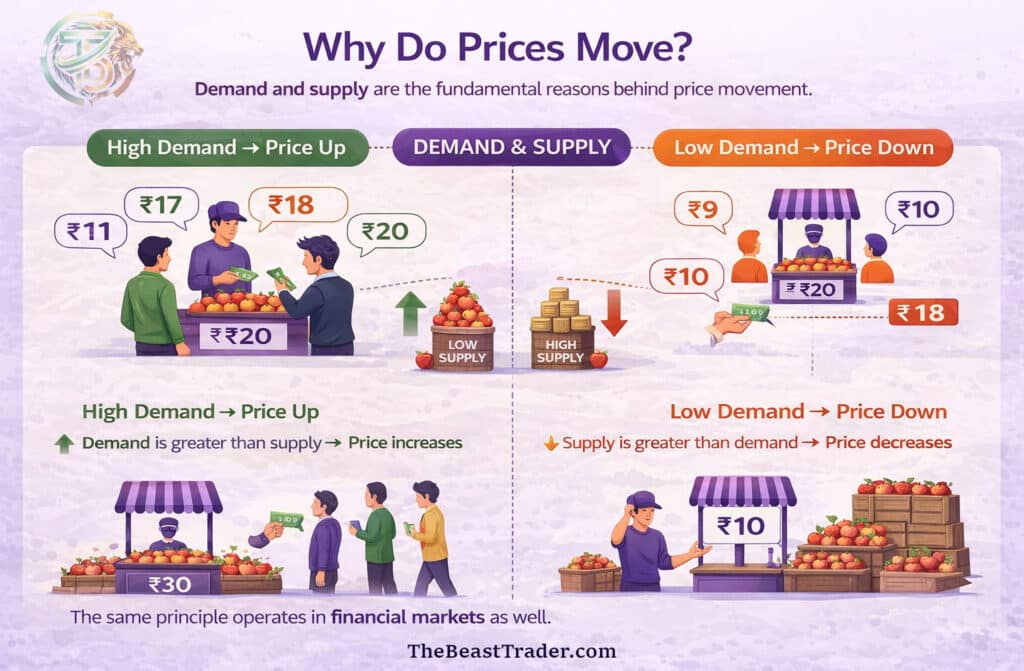
Markets are nothing more than a constant interaction between buyers and sellers.
From my experience, price movement usually falls into three simple situations.
1. When Buyers Dominate the Market
If a large number of traders want to buy an asset — whether it is Reliance shares, Bitcoin, or Gold — demand increases.
And whenever demand increases, prices rise.
For example:
If many investors suddenly start buying Bitcoin, its price might move from $50,000 to $55,000 simply because buyers are dominating the market.
2. When Sellers Dominate the Market
On the other hand, if traders start selling aggressively, supply increases.
And when supply increases, prices fall.
For example:
If institutional traders start selling Gold futures, the price might drop from ₨. 60,000 to ₨.58,000 per 10 grams.
The reason is simple — there are more sellers than buyers.
3. When Buyers and Sellers Are Balanced
Sometimes neither buyers nor sellers dominate the market.
In that situation, the price simply moves sideways.
This happens very often in:
- Forex currency pairs like EUR/USD
- Consolidating stocks
- Range-bound crypto markets
During these phases, the market waits for new information or strong momentum before deciding its next direction.
The Hidden Force Behind Market Movement

One thing many beginners underestimate is market psychology.
Markets are driven by human emotions.
- Optimism creates bullish trends
- Fear creates bearish trends
- Uncertainty creates sideways markets
When thousands of traders act together, their collective behavior becomes surprisingly predictable.
This is why experienced traders often focus on identifying moments when other traders are under stress.
Because stress often creates powerful trading opportunities.
How I Make Money When Prices Go Up (Long Position)

Let’s start with the most common strategy.
Suppose I analyze a stock like Infosys and believe its price will increase.
Today the stock is trading at ₨1,450.
I buy the stock and hold it.
In trading language, we call this going long.
If the price rises to ₨1,520, I sell it.
My profit becomes:
₨1,520 – ₨1,450 = ₨70 per share
This type of trade is called a long trade.
But here is something many beginners don’t know.
How I Make Profit When the Market Falls (Short Selling)
A falling market does not mean profit opportunities disappear.
In fact, many professional traders love falling markets.
Because they use a concept called short selling.
Short selling simply means:
Sell first, buy later.
A Simple Real-Life Example
Let me explain this with a very simple situation.
Suppose my friend Arjun wants to sell his gaming laptop for ₨55,000.
At the same time, another friend Vikram wants to buy a similar laptop.
So I tell Vikram:
“I can arrange this laptop for you for ₨65,000.”
He agrees and gives me an advance.
Now I buy the laptop from Arjun for ₨55,000 and deliver it to Vikram.
My profit becomes:
₨65,000 – ₨55,000 = ₨10,000
Notice something interesting.
I did not own the laptop initially, yet I still made a profit by connecting the buyer and seller.
This is exactly how short selling works in financial markets.
Short Selling Example in the Stock Market
Suppose a stock like HDFC Bank is trading at ₨1,600.
After analyzing the trend, I believe the price may fall to ₨1,520.
Instead of buying the stock, I sell it first at ₨1,600.
Later, when the price falls to ₨1,520, I buy it back.
Profit:
₨1,600 – ₨1,520 = ₨80 per share
This entire process happens in intraday trading.
The Same Concept Works in Gold, Crypto and Forex
The beautiful thing about financial markets is that the same logic applies everywhere.
Gold Trading
If Gold is trading at ₨60,000 and I believe it will fall, I can short it.
If it falls to ₨59,200, the difference becomes profit.
Crypto Trading
Suppose Ethereum is trading at $3,000.
If I short Ethereum and the price drops to $2,700, I profit from the decline.
Crypto exchanges allow traders to short using futures or margin trading.
Forex Trading
In forex trading, this concept is even more natural.
When trading USD/JPY or EUR/USD, you are always:
- buying one currency
- selling another currency
So traders constantly take both long and short positions.
Intraday Trading vs Long-Term Investing
There are two main ways people participate in markets.

Delivery / Long-Term Investing
Investors buy assets and hold them for long periods.
Example:
Buying Gold ETF or Apple stock and holding it for years.
Intraday Trading
Traders open and close positions within the same trading day.
Advantages include:
- Ability to short sell
- Access to margin or leverage
- Faster profit opportunities
But it also comes with higher risk.
The Four Elements of a Strong Trading Edge
After observing thousands of trades, I believe consistent profit requires a strong trading edge.
This edge usually comes from four key elements.

1. Spotting Traders Under Stress
One of the most powerful opportunities occurs when many traders are forced to exit positions.
This usually happens during:
- panic selling
- stop loss cascades
- sudden news events
These moments often create sharp price movements.
2. Mental Discipline
Trading success is not only about strategy.
It is also about emotional control.
You must stay:
- calm
- focused
- confident
Otherwise fear and greed will control your decisions.
3. Strong Risk Management
Even the best traders are wrong sometimes.
So every trade must be planned carefully.
The real goal is simple:
Keep losses small and allow profits to grow.
4. Experience Matters
No book or course can replace real trading experience.
The more time you spend observing charts and executing trades, the better you become at:
- reading trends
- managing risk
- controlling emotions
The Real Key to Consistent Profit
If there is one lesson I wish someone told me earlier, it would be this:
Follow the trend.
When the market is bullish, look for buying opportunities.
When the market is bearish, look for short selling opportunities.
Trying to fight the trend usually leads to losses.
Final Thoughts
Markets will always contain uncertainty.
Prices will move up, down, and sideways depending on the interaction between buyers and sellers.
But if you focus on:
- understanding price movement
- maintaining discipline
- managing risk
- gaining experience
you gradually develop the trading edge needed for consistent profit.
And once you truly understand how markets work, you will realize something powerful:
Profit opportunities exist in stocks, gold, crypto, and forex — regardless of whether prices are rising or falling.
Written By-
Arvind Singh (The Beast Trader)