Global markets have once again been thrown into turbulence after a dramatic legal and political shift in U.S. trade policy. The U.S. Supreme Court’s decision overturning key Trump-era tariff structures has reignited uncertainty across Wall Street, while fresh comments about raising tariffs to 15% “where appropriate” have added another layer of volatility.
What’s emerging from this chaos is not just policy confusion—but a new speculative opportunity: tariff-refund claims trading. At the same time, forex, crypto, gold, and commodity markets are recalibrating rapidly to the changing macro landscape.
Let’s break down what’s happening—and what it means for traders.
The Supreme Court Ruling & Tariff Repricing
The Supreme Court’s decision to strike down parts of the previous tariff framework triggered an immediate reassessment of billions of dollars in collected import duties. Businesses that paid higher tariffs on imported goods are now seeking refunds, and investors have quickly stepped in to buy rights to those claims.
Before the ruling, tariff-refund claims were reportedly trading at deep discounts—around 20 cents on the dollar. After the court decision, prices jumped toward 40–45 cents, reflecting rising confidence that companies might eventually recover their money.
This has created a secondary market where hedge funds and claims-focused investment firms are purchasing refund rights from businesses that prefer immediate liquidity rather than waiting years for legal resolution.
In simple terms:-
- Businesses want cash now.
- Investors are willing to wait for a potentially larger payout.
- The court ruling increased the probability of repayment.
- That probability repricing caused the jump in claim values.
It’s similar to distressed debt investing—but this time, tied to global trade policy.
Trump’s Proposed 15% Tariff Hike: A Fresh Macro Catalyst
Just as markets were digesting the legal shock, new guidance signaled that the U.S. could raise global tariffs to 15% “where appropriate,” while maintaining 35–50% levies on certain Chinese goods.
A 10% global tariff was already in place. A move to 15% would:
- Increase import costs.
- Raise inflationary pressures.
- Disrupt supply chains.
- Potentially strain trade relations with the EU, UK, and Asia.
This creates a dual force in markets:
- Short-term uncertainty
- Long-term structural repricing of trade flows
Investors are now trying to price in whether this is negotiation leverage—or the beginning of a more protectionist era.
Market Impact Breakdown
Now let’s examine how this affects key asset classes.
1. Forex Market Impact
Tariffs directly influence currency flows because they alter trade balances and capital movement.
US Dollar (USD)
In the short term, tariffs often strengthen the dollar due to:
- Risk-off flows into U.S. assets
- Reduced imports (lower demand for foreign currencies)
However, longer term:
- Higher tariffs can slow economic growth.
- Retaliatory trade measures can hurt exports.
- Inflationary pressure may complicate Federal Reserve policy.
If tariffs push inflation higher while growth slows, we could see stagflation fears, which would eventually weaken USD.
Chinese Yuan (CNY)
If 35–50% tariffs remain on Chinese goods:
- Export pressure increases.
- China may allow controlled currency depreciation.
- Capital outflows could rise.
Euro & Pound
If European exports face higher U.S. tariffs:
- EUR and GBP may weaken.
- European manufacturing sentiment could decline.
- ECB policy may tilt more dovish.
Forex Trading Outlook: Expect increased volatility in USD/CNY, EUR/USD, and safe-haven pairs like USD/JPY and USD/CHF.
2. Gold Market Reaction
Gold thrives on:
- Political uncertainty
- Inflation fears
- Dollar instability
Tariffs are inflationary by nature because they increase input costs. If businesses pass these costs onto consumers, CPI rises.
Higher inflation + trade uncertainty = bullish medium-term setup for gold.
However:
- If the dollar strengthens sharply first, gold may face short-term pressure.
- Real yields remain the key driver.
Gold Bias: Volatile but structurally supported if tariff tensions escalate.
3. Commodities (Oil, Industrial Metals, Agriculture)
Tariffs disrupt global supply chains. That means commodities can react in two opposing ways:
Crude Oil
- Trade slowdowns reduce global demand.
- But geopolitical risk premiums increase.
If tariff tensions escalate into broader economic slowdown fears, oil could face downside pressure.
Copper & Industrial Metals
- Sensitive to global growth.
- China demand matters heavily.
- Higher tariffs on Chinese goods could indirectly weaken industrial demand.
Agricultural Commodities
- Highly vulnerable to retaliatory tariffs.
- Soybeans, corn, and meat exports often become bargaining tools in trade disputes.
Commodity Outlook: Expect rotational volatility, with industrial metals most exposed to trade uncertainty.
4. Crypto Market Impact
Crypto reacts more to liquidity conditions than tariffs directly—but there are indirect channels.
If tariffs:
- Slow growth
- Increase inflation
- Create financial instability
Then investors may turn toward Bitcoin as:
- A hedge against fiat instability
- A politically neutral asset
However, if tariff shocks cause:
- Equity sell-offs
- Risk-off deleveraging
Crypto may initially drop alongside equities before recovering.
Historically:
- Short-term: Correlates with risk assets.
- Medium-term: Benefits from macro instability narratives.
Crypto Outlook: High volatility; potential upside if policy uncertainty persists.
5. U.S. Stock Market Implications
Tariffs directly hit corporate margins.
Companies relying on imports face:
- Higher costs
- Reduced profitability
- Pricing power challenges
Large multinational firms are particularly exposed. Smaller domestic companies may feel less pressure but still face input cost inflation.
At the same time:
- Claims trading has created a niche speculative opportunity.
- Legal-finance funds are gaining attention.
- Secondary markets for tariff refund rights may expand.
This creates a strange divergence:
- Some businesses suffer from tariffs.
- Some investors profit from refund speculation.
Impact on Indian Markets
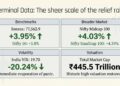
India may not be directly targeted by the proposed U.S. tariff hike, but the ripple effects could still be significant. If global trade tensions escalate, foreign institutional investors (FIIs) may shift capital toward safe-haven U.S. assets, putting short-term pressure on the Indian rupee and equity markets. A stronger U.S. dollar typically weakens emerging market currencies, which could push USD/INR higher. At the same time, higher global tariffs could slow worldwide demand, impacting Indian export-driven sectors such as IT services, pharmaceuticals, auto components, and specialty chemicals. However, India could also emerge as a relative beneficiary if global supply chains diversify away from China, attracting manufacturing investments under the “China+1” strategy. For commodities, rising gold prices would likely support domestic gold demand trends, while crude oil volatility could directly affect India’s trade deficit and inflation outlook. Overall, Indian markets may experience short-term volatility but could see selective long-term opportunities depending on how global trade realignment unfolds.
The Rise of Tariff-Refund Trading
One of the most fascinating developments is the formalization of a market for tariff refund claims.
Investors are:
- Buying claims from businesses.
- Pricing legal risk.
- Calculating time value of money.
- Estimating probability of government repayment.
If total refund exposure runs into the tens or even hundreds of billions of dollars, this could become a multi-year trading niche.
It mirrors:
- Bankruptcy claims trading.
- Tax refund securitization.
- Litigation finance models.
For hedge funds, this is asymmetric:
- Buy at 40 cents.
- Potential payout near 100 cents.
- Long legal timeline.
For companies, it’s a liquidity decision.
Macro Themes to Watch
- Will tariffs stay at 10%, rise to 15%, or escalate further?
- Will China retaliate?
- Will inflation reaccelerate?
- How will the Federal Reserve respond?
- Will refund litigation stretch for years?
Each answer reshapes forex, gold, crypto, and commodities differently.
Final Trading Perspective
We are entering a policy-driven volatility cycle.
Tariffs are not just political tools—they are macroeconomic shockwaves. The Supreme Court ruling has unlocked refund speculation, while new tariff threats have revived trade-war fears.
For traders:
- Forex: Watch USD strength vs. trade-sensitive currencies.
- Gold: Monitor inflation expectations and real yields.
- Crypto: Track liquidity and risk sentiment.
- Commodities: Focus on China demand signals.
- Equities: Margin compression risks remain real.
In this environment, volatility is not the enemy—it’s the opportunity.
The tariff era may be evolving, but one thing is certain:
Markets are repricing risk—and traders who understand the cross-asset impact will be best positioned to navigate the storm.
Written By – Arvind Singh