The SEBI Mutual Fund New Rules 2026 represent one of the most significant regulatory reforms in India’s asset management industry in recent years. The capital markets regulator has tightened mutual fund classification norms, capped portfolio overlap, discontinued solution-oriented schemes, introduced lifecycle funds, and revised gold and silver valuation standards to improve transparency and investor protection.
These reforms are structural in nature and are aimed at ensuring that mutual fund schemes remain “true to label,” reduce duplication, and align valuation practices with domestic market benchmarks.
Let us break down what has changed and what realistic impact these reforms may have on Indian equities, gold and silver markets, commodities, forex, and crypto.
What Do SEBI Mutual Fund New Rules 2026 Change in Equity Schemes?
One of the key pillars of the reform is reducing excessive portfolio overlap among mutual fund schemes.
Over the years, many sectoral and thematic funds were found to hold similar stocks despite carrying different labels. This reduced diversification benefits for investors and created confusion in product positioning.
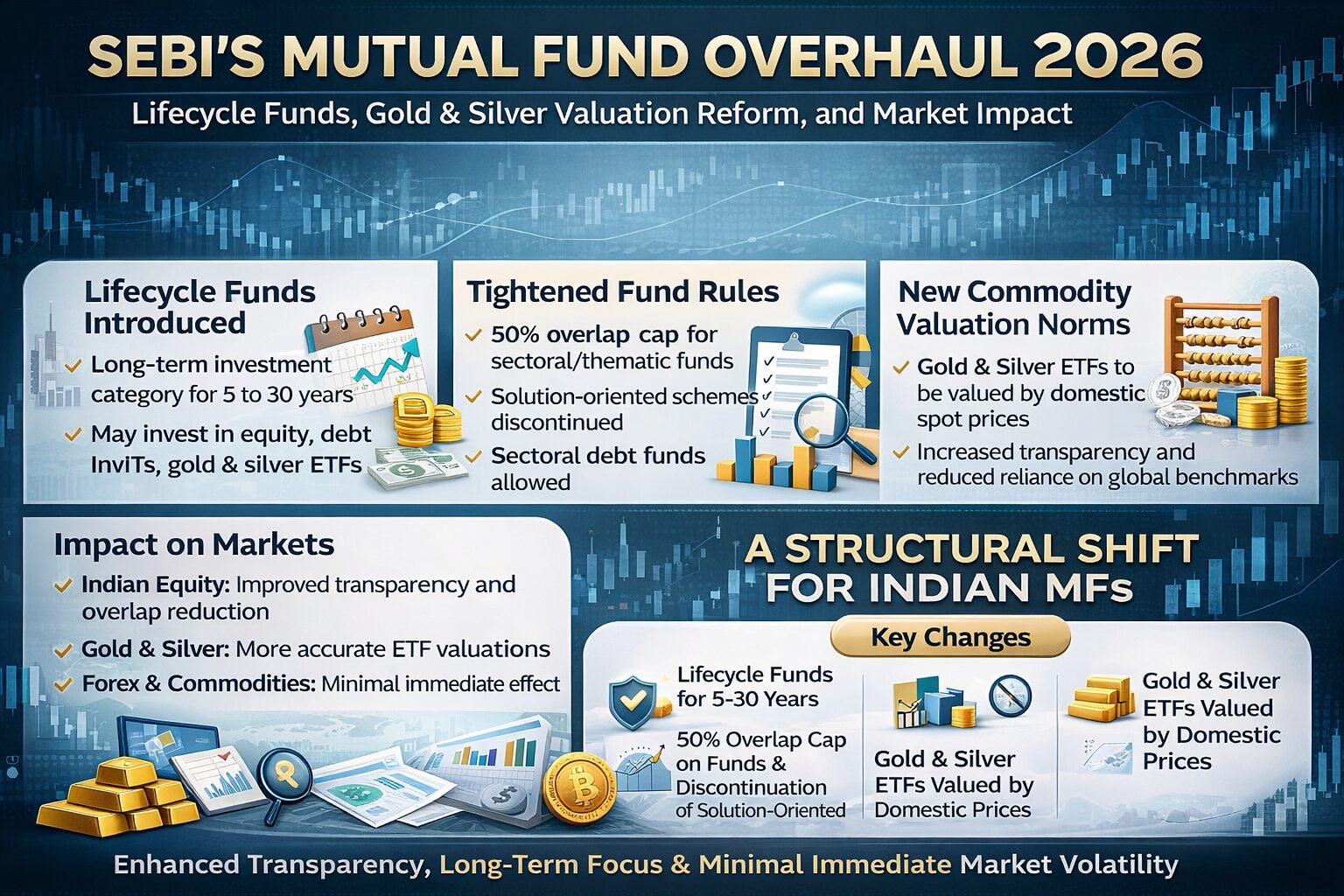
Under the SEBI Mutual Fund New Rules 2026, a 50% cap has been imposed on portfolio overlap between sectoral and thematic equity schemes within the same asset management company (AMC). Large-cap schemes are excluded from this condition.
The overlap will be calculated quarterly based on the average of daily portfolio holdings. Existing schemes have been given a transition period of three years to comply. If a scheme fails to meet the required threshold after the transition period, it may have to merge with another scheme.
This reform is designed to improve transparency and ensure investors are not unknowingly investing in nearly identical portfolios under different fund names.
Discontinuation of Solution-Oriented Schemes
Another major development under the SEBI Mutual Fund New Rules 2026 is the discontinuation of solution-oriented schemes such as retirement funds and children’s education funds.
These schemes will stop accepting fresh inflows and will be transitioned into a newly structured category called lifecycle funds. The move eliminates marketing-driven labels and replaces them with a more standardized long-term investment framework.
SEBI Mutual Fund New Rules 2026: Lifecycle Funds Explained
Lifecycle funds are a newly introduced category aimed at long-term goal-based investing with structured flexibility.
Key features include:
- Minimum duration of five years
- Maximum duration of up to 30 years
- Ability to invest across multiple asset classes including equity, debt, infrastructure investment trusts (InvITs), exchange-traded commodity derivatives, gold ETFs, and silver ETFs
Unlike previous retirement or children’s funds, lifecycle funds are not restricted by rigid labeling. Instead, they offer a structured investment approach aligned with long-term financial planning horizons.
This change brings clarity in scheme classification while still allowing diversified asset allocation within regulatory limits.
Sectoral Debt Funds Introduced
The regulator has also allowed AMCs to launch sector-specific debt mutual funds.
Under this framework:
- At least 80% of investments must be in debt instruments of a particular sector
- Eligible sectors may include financial services, energy, infrastructure, and housing
- Investments will primarily be in corporate bonds and instruments rated above AA+
The introduction of sectoral debt funds expands product innovation but within tightly controlled risk parameters.
Gold & Silver Valuation Under SEBI Mutual Fund New Rules 2026
One of the most operationally significant changes relates to the valuation of physical gold and silver held by mutual funds.
Previously, gold and silver valuation relied heavily on international benchmarks adjusted for currency conversion and import-related costs. Now, under the SEBI Mutual Fund New Rules 2026, valuation must be based on regulated domestic spot prices.
The final NAV will be calculated after adjusting for:
- Currency conversion
- Transport costs
- Customs duties
- Applicable taxes and levies
- Premium or discount factors
This new framework aims to ensure uniformity, transparency, and better alignment between domestic commodity prices and mutual fund NAV calculations.
The revised valuation norms will come into effect from April 1.
Residual Portion Investment Flexibility
Equity-oriented schemes are now permitted to invest their residual portion (the portion beyond core asset allocation requirements) in gold, silver, InvITs, debt instruments, and other liquid assets, within prescribed regulatory limits.
For example, if a large-cap fund must invest 80% in top 100 companies, the remaining 20% may be allocated to approved asset classes including precious metals.
This provides tactical diversification flexibility without altering the core investment mandate.
Realistic Impact on Indian Stock Market
The impact of the SEBI Mutual Fund New Rules 2026 on Indian equities is structural rather than immediate.
Short-term effects may include:
- Portfolio adjustments within sectoral and thematic funds
- Scheme mergers in cases of excessive overlap
- Minor rebalancing in specific sectors
However, this reform does not inject or withdraw liquidity from markets directly. Therefore, broad indices are unlikely to experience sharp volatility solely due to these regulatory changes.
Over the medium term, improved transparency and clearer scheme categorization may enhance investor confidence and long-term participation in equity markets.
Impact on Indian Gold and Silver Markets
The new gold and silver valuation framework primarily affects NAV calculation methodology rather than physical demand or supply.
The expected impact includes:
- Better alignment between mutual fund NAV and domestic spot pricing
- Reduced valuation discrepancies
- Increased transparency in precious metals ETF pricing
This reform does not automatically increase gold demand. Instead, it standardizes valuation practices and reduces pricing inconsistencies.
Impact on Indian Commodity Markets
Since lifecycle funds and residual equity portions can invest in exchange-traded commodity derivatives and precious metals ETFs, there may be gradual institutional participation growth in regulated commodity segments.
However, exposure remains limited by regulatory ceilings. Therefore, the effect is incremental rather than disruptive.
Impact on Forex Market
The valuation shift toward domestic spot pricing reduces reliance on offshore benchmarks.
While adjustments for currency conversion will still apply, this change is primarily procedural. It is unlikely to significantly affect currency volatility or capital flows in the forex market.
Impact on Crypto Market
There is no direct regulatory linkage between the SEBI Mutual Fund New Rules 2026 and cryptocurrency markets.
Indirectly, improved clarity and diversification options within regulated financial products may strengthen traditional investment channels. However, there is no measurable direct impact on crypto assets implied by the reform.
Why This Reform Is Structurally Important
India’s mutual fund industry has expanded rapidly in recent years, both in assets under management and product diversity. With growth came overlapping portfolios, marketing-driven scheme positioning, and labeling ambiguity.
The new framework prioritizes:
- True-to-label compliance
- Portfolio differentiation
- Transparent valuation practices
- Standardized scheme naming conventions
These measures strengthen regulatory discipline without restricting innovation.
What Investors Should Watch Going Forward
Investors should monitor:
- Scheme mergers over the next three years
- Launch of lifecycle funds replacing discontinued categories
- Introduction of new sectoral debt funds
- Changes in fact sheets reflecting overlap compliance
- Updated NAV methodology disclosures for gold and silver funds
Final Takeaway
The SEBI Mutual Fund New Rules 2026 represent a structural evolution in India’s mutual fund regulation. Rather than triggering short-term market volatility, these reforms aim to enhance transparency, reduce duplication, and improve valuation consistency.
For investors, the message is clear: the regulatory environment is moving toward greater discipline and clarity, which supports sustainable long-term capital market growth.
Written & Analyzed By
Arvind Singh
The Beast Trader